Introduction
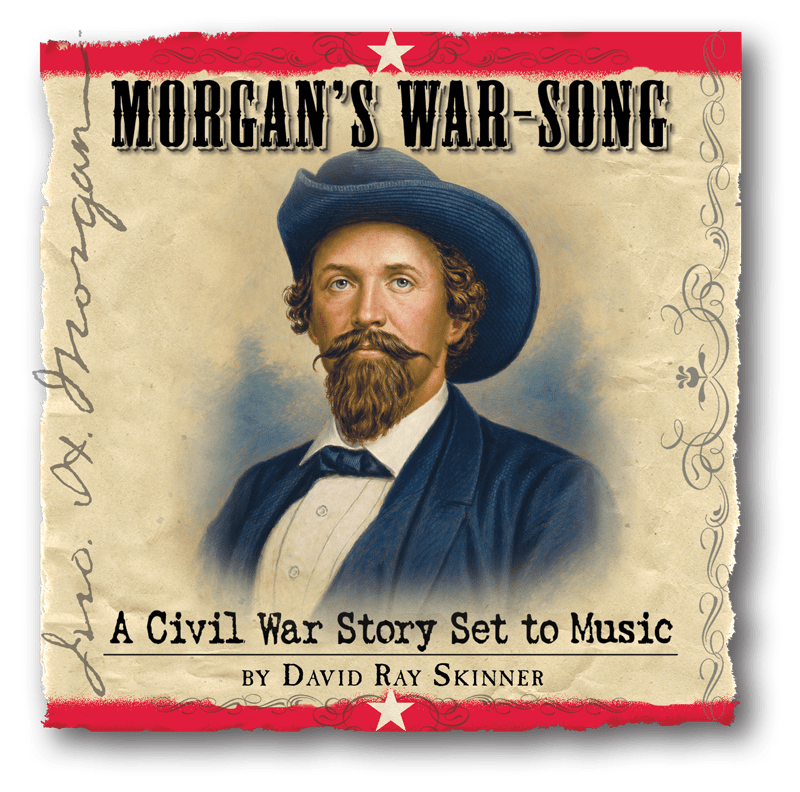
John Hunt Morgan was killed on September 4, 1864, by a Confederate soldier who had defected to the Union. A veteran of the Mexican-American War, Morgan had previously settled in Kentucky, where he operated a hemp factory and organized the Lexington Rifles, a pro-Southern militia. This account follows Morgan’s life through the American Civil War, beginning with his enlistment in the Confederate Army in October 1861 and ending with that fateful bullet.
Becky
In 1848, Morgan married Rebecca Bruce, the sister of his business partner. Shortly after, “Becky” fell into ill health. Dedicated to her recovery, Morgan took her to specialists across the country—from New Orleans to Hot Springs—in a desperate search for a cure. Despite his efforts, she suffered through years of chronic pain before passing away in July 1861.
Oh Kentucky!/Ride Away
In 1861, Kentucky attempted to maintain a stance of neutrality, but the escalating conflict forced Morgan and his fellow Kentuckians to choose sides. As a pro-Southern business owner, Morgan defiantly flew the Rebel flag over his factory; as a militia commander, he was viewed by the North as a significant threat. When Morgan successfully smuggled his militia’s rifles out of town—leaving empty crates for Federal authorities to “confiscate”—an arrest warrant was issued. Having lost his wife to illness and his factory to the law, Morgan felt he had nothing left to live for but the cause of the new Republic.
Butternut Grey
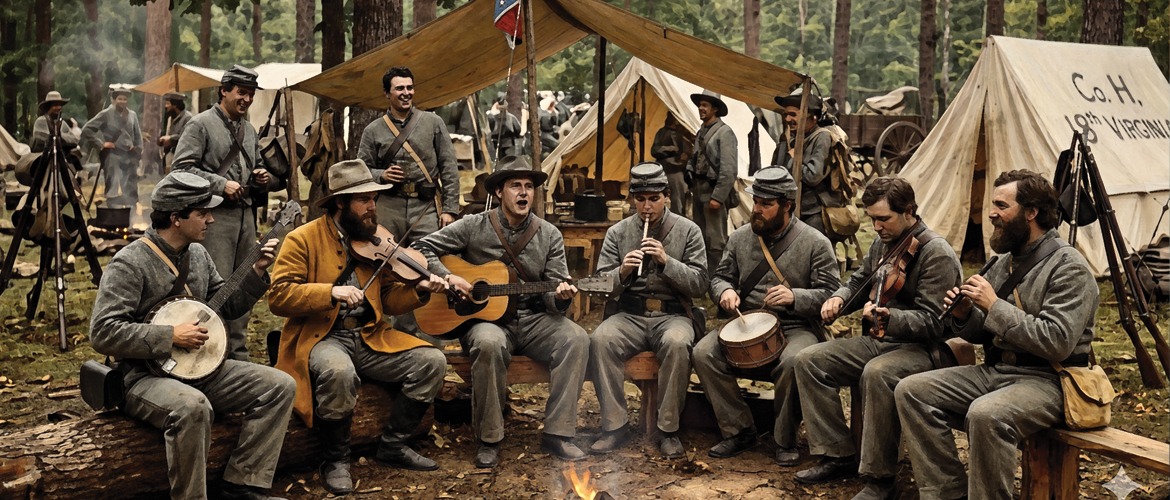
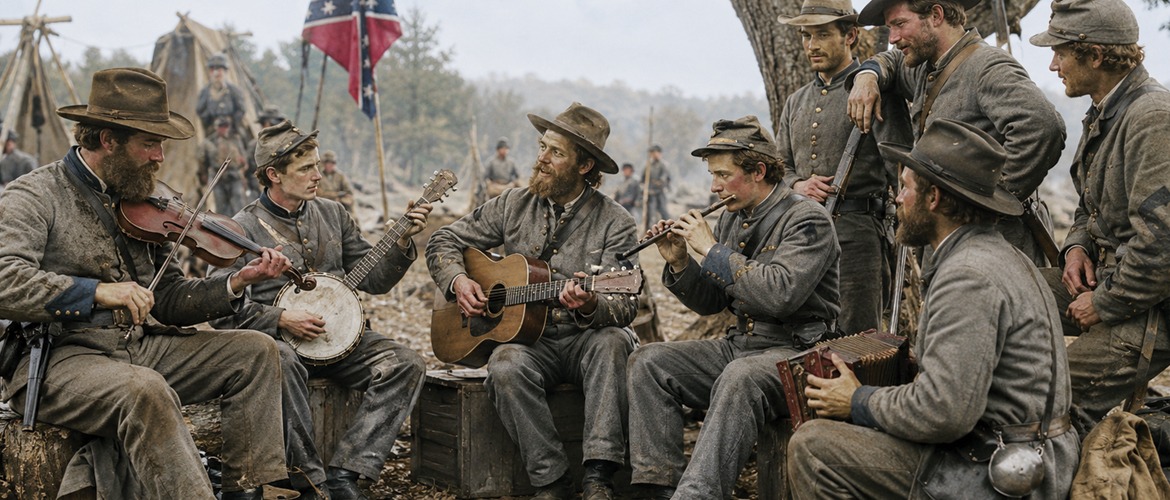
Morgan officially joined the Confederacy and assumed command in the autumn of 1861. He was eventually joined by five of his brothers: Tom (who had enlisted earlier in July), Cal, Charlton, Dick, and Key. The term “Butternut Grey” refers to the distinct color of their Confederate uniforms, which were dyed using the bark of the butternut (white walnut) tree.
Cheer, Boys, Cheer
Early in the War, Morgan’s Raiders were joined by George St. Leger Grenfell, a seasoned British soldier bearing introductions from Generals Lee and Beauregard. Grenfell claimed an exhaustive military pedigree, asserting he had fought in the Crimean War, the Sepoy Mutiny, and across South America and North Africa. Driven by a restless martial spirit, he famously remarked: “If England is not at war, I go elsewhere to find one.” Beyond his tactical expertise, Grenfell introduced the regiment to “Cheer, Boys, Cheer,” a popular 1850 British military song. Already a staple of the Victorian-era British Army, the anthem was adopted by Morgan’s Men and became their definitive rallying cry in battle.
Lightning on the Wire/Communication Breakdown
George Ellsworth, a Canadian-born telegraph operator, was one of Morgan’s most unconventional assets. Tasked with disrupting Union lines, Ellsworth would “milk the wires”—intercepting enemy intelligence before sending out deceptive dispatches to misdirect Union commands. He earned his famous nickname, “Lightning,” during a raid when he successfully tapped a wire in the middle of a thunderstorm.
Asylum Raid
Upon learning that the 4th Ohio had made camp on the grounds of a lunatic asylum outside Nashville, Morgan and his men donned captured blue uniforms to approach undetected. Disguised as Union soldiers, they began picking off the unsuspecting Federals. By the time the ruse was discovered, Morgan had taken over 80 prisoners, leading to a sharp skirmish in the literal shadow of the asylum.
Morgan’s War-Song
This stirring call to arms was a poem written by General Basil W. Duke, Morgan’s brother-in-law and brilliant second-in-command. After Morgan liberated Hartsville, Tennessee, from Union forces, he commandeered an abandoned newspaper office to establish his own publication, The Vidette. The paper served as a propaganda tool, detailing Union atrocities and Morgan’s “brilliant” exploits; its front page was famously anchored by “Morgan’s War-Song.”
Black Clouds Above the L&N
Drawn from Basil Duke’s 1867 memoir, History of Morgan’s Cavalry, this account details two high-stakes raids on the Louisville & Nashville (L&N) Railroad, the primary supply artery for Union-occupied Nashville.
- The Gallatin Tunnels: In the first raid, Morgan’s men and local townspeople barricaded the L&N’s twin tunnels above Gallatin, Tennessee, with crossties and timber. They then sent a captured locomotive hurtling into the debris at full steam. The resulting explosion ignited a coal vein in the tunnel’s ceiling, sealing the passage for 98 days. Shortly after, Morgan had to return to rescue the town’s elderly men and young boys, whom the enraged Union forces were marching off to prison.
- The Christmas Raid of 1862: In his most infamous strike, Morgan captured and burned several L&N bridges, most notably the Muldraugh Trestles. These trestles were the railroad’s most vulnerable strategic points; their destruction paralyzed the Union supply line for five weeks.
In a twist of historical irony, Basil Duke spent his post-war years practicing law as the chief counsel and lobbyist for the very railroad he once fought to destroy, helping the L&N establish a powerful monopoly across the South.
The Congressman’s Daughter
While establishing his headquarters in Murfreesboro, Morgan became acquainted with Colonel Charles Ready, a prominent attorney and former U.S. Congressman. Morgan was immediately captivated by Ready’s daughter, Mattie, and after a whirlwind courtship, the two became engaged in March 1862. They were married that December; however, the honeymoon was short-lived, as Morgan departed for his famous Christmas Raid immediately after the ceremony. This union marked a turning point in his life: the reckless abandon and singular devotion he once held for his men began to be eclipsed by his deep love for Mattie.
Half-Past Chattanooga
Morgan led several successful operations, but his most famous—and ultimately ill-fated—was the Great Raid of 1863. Hoping to eventually link up with Lee in Pennsylvania, Morgan set out with 2,500 men on a mission he had kept secret from his superiors. Aided by “Lightning” Ellsworth’s deceptive telegraphs, Morgan tore through Kentucky and Indiana, destroying bridges and disrupting rail lines. Even as several Union regiments began a frantic pursuit, he pushed further north into Ohio. His strategy was to bring the chaos of war directly to the Northern populace before slipping back across the Ohio River. However, his luck ran out: heavy rains had swollen the river to record levels, and Lee was defeated at Gettysburg. After reaching further north than any other Confederate force and destroying millions of dollars in property, Morgan was finally captured just 90 miles from Lake Erie.
Mattie’s Eyes
This piece is inspired by the poignant letters Morgan wrote to Mattie during his incarceration in the Ohio State Penitentiary. Penned by candlelight in the quiet of his cell, these letters were deeply poetic, brimming with devotion for his wife and the child they were expecting. They reveal a softer, more reflective side of the man known to the North as the “Rebel Raider.”
Psalms 60/142
Under Mattie’s influence, the once-secular Morgan began to find solace in faith. During his imprisonment, his Bible became a constant companion and a source of profound comfort. In his correspondence, he confided to Mattie that he had been intensely studying the Psalms. He may have noted a bitter irony in his reading: the verse “Judah is my lawgiver” appears in both Psalms 60 and 108. In Morgan’s world, however, General Henry M. Judah was the Union officer who had finally succeeded in cornering and capturing him.
Less Miserable
In March 1862, Victor Hugo published Les Misérables, a masterpiece of 19th-century literature exploring justice and redemption. During their imprisonment, Morgan’s Men acquired a copy—likely smuggled in by Kentucky supporters—and felt an immediate kinship with the protagonist, Jean Valjean. In his memoir, A History of Morgan’s Cavalry, Basil Duke noted that the novel obsessed the inmates, claiming Hugo had perfectly “daguerreotyped” a prisoner’s psyche. Duke recalled that the book was the first thing on their minds in the morning and the last at night. Given this intense fascination, Hugo’s depiction of Valjean’s escape through the Paris sewers may well have inspired the plan for Morgan’s own daring underground flight.
Stars and Bars
“Stars and Bars,” a common moniker for the Confederate flag, serves as the backdrop for the story of Captain Samuel Taylor. Taylor was one of Morgan’s trusted officers and was captured alongside him in Ohio. Defying standard military protocol, Union authorities refused to treat the group as prisoners of war, instead confining them to the Ohio State Penitentiary. While several escape plots were debated, Captain Thomas H. Hines devised the most viable plan: a tunnel. Realizing an airshaft likely ran beneath their ground-floor cells, the men began painstakingly scraping through the concrete. They hid the debris in their bed ticking, the furnace, and beneath a carpetbag used to mask the hole. Once inside the airshaft, they tunneled horizontally and then upward toward six other cells, stopping just a fraction of an inch below the floorboards so the “plugs” could be kicked out on a moment’s notice. Fearing the prison’s guard dogs, they waited for a rainy night to mask their scent and sound. However, when news broke of an impending change in prison command—and a subsequent total-cell inspection—the men were forced to act. On the rainy night of November 27, 1863, Morgan, Taylor, Hines, and four others made their move. While Morgan and four others successfully navigated back to Southern lines, Sam Taylor and one other escapee were tragically recaptured.
This Southbound Train
Preparation was key to their flight; Morgan’s men had pre-staged civilian clothes, money, and a railroad timetable inside the tunnel. After emerging from the prison walls, the seven escapees split into small groups to avoid suspicion. Morgan and Thomas Hines paired off and boarded the midnight train out of Columbus. In a display of characteristic audacity, Morgan sat directly beside a Union officer and struck up a friendly conversation. As the train steamed past the high walls of the penitentiary, the officer gestured toward it and remarked, “There’s the ‘hotel’ where Morgan and his officers are spending their leisure.” Morgan laughed and replied, “Yes, I hope he stays as safe as he is now.”
The Gypsy’s Letter
While planning his return to the field, Morgan received a mysterious letter from an unknown woman in Kentucky. Claiming a premonition, she begged him to remain in hiding, warning that if he attempted to ride south to resume his raids, his life would be in grave danger. Morgan, never one to be deterred by superstition or shadow, chose to ignore the warning. He turned his horse toward East Tennessee, riding straight toward the final chapter of his life.
Cheer, Boys, Cheer
Upon his return to the South, Morgan found his military career in a state of collapse. His unauthorized foray into Ohio had cost him the trust of his superiors, who now actively sought his court-martial for insubordination. Simultaneously, a humiliated and vengeful Union Army had placed a high price on his head, vowing to recapture him—dead or alive. In this context, the Raiders’ once-boisterous marching song is transformed into a somber lament for a fading legend.
The Other Side
Composed in the tradition of an Appalachian folk hymn, this piece serves as a haunting premonition. It reflects the growing sense of mortality surrounding Morgan and his men as the shadow of the war’s end began to lengthen over the Confederacy.
The Greene County Line
On the morning of September 4, 1864, Morgan and his men were caught in a surprise Union ambush in Greeneville, Tennessee. Having promised Mattie that he would never again endure the indignity of imprisonment, Morgan attempted a desperate escape. He was shot in the back while running for his horse, dying on the grounds of the Williams mansion. Following his death, Basil Duke assumed command of the remnants of the “ragtag” cavalry, leading them through the final, crumbling days of the war. In a final act of duty, Duke’s men escorted Confederate President Jefferson Davis to the Savannah River on the Georgia-South Carolina border. There, they divided the remaining gold in the Confederate treasury among the soldiers. With no hope of escape and the cause lost, they surrendered a few days later. Morgan left behind a grieving widow and a daughter, Johnnie, who was born just a few months after the father she would never know was laid to rest.
The Flip Book
For more details (and illustrations) on each song in the collection, click here to launch the Morgan’s War-Song flip book: https://www.morganswarsong.com/MorgansWarSong/MorgansWarSong.html